

Are Four Points Always Coplanar
In geometry, a set of points in infinite are coplanar if in that location exists a geometric plane that contains them all. For instance, 3 points are ever coplanar, and if the points are distinct and non-collinear, the plane they determine is unique. Nonetheless, a gear up of four or more distinct points will, in general, not lie in a single plane.
Two lines in 3-dimensional infinite are coplanar if in that location is a aeroplane that includes them both. This occurs if the lines are parallel, or if they intersect each other. 2 lines that are not coplanar are called skew lines.
Distance geometry provides a solution technique for the problem of determining whether a gear up of points is coplanar, knowing just the distances betwixt them.
Backdrop in three dimensions [edit]
In three-dimensional space, two linearly independent vectors with the aforementioned initial betoken determine a plane through that indicate. Their cross product is a normal vector to that plane, and any vector orthogonal to this cantankerous product through the initial signal will lie in the plane.[1] This leads to the following coplanarity test using a scalar triple production:
Four singled-out points, x ane, x ii, x three and 10 4 are coplanar if and only if,
![{\displaystyle [(x_{2}-x_{1})\times (x_{4}-x_{1})]\cdot (x_{3}-x_{1})=0.}](https://wikimedia.org/api/rest_v1/media/math/render/svg/40301d3d515637e356b2c4bbc59752c0af16aed8)
which is as well equivalent to
![{\displaystyle (x_{2}-x_{1})\cdot [(x_{4}-x_{1})\times (x_{3}-x_{1})]=0.}](https://wikimedia.org/api/rest_v1/media/math/render/svg/3db4d390d2bc551af8977323d5309a3cfbfc3b82)
If three vectors a, b and c are coplanar, so if a⋅b = 0 (i.e., a and b are orthogonal) so

where denotes the unit of measurement vector in the direction of a . That is, the vector projections of c on a and c on b add to give the original c .

Coplanarity of points in due north dimensions whose coordinates are given [edit]
Since three or fewer points are always coplanar, the trouble of determining when a set of points are coplanar is by and large of interest only when there are at least iv points involved. In the case that there are exactly iv points, several ad hoc methods can exist employed, only a general method that works for any number of points uses vector methods and the belongings that a aeroplane is adamant past two linearly independent vectors.
In an northward -dimensional space ( n ≥ 3), a fix of k points, {p 0, p i, ..., p g − 1} are coplanar if and simply if the matrix of their relative differences, that is, the matrix whose columns (or rows) are the vectors is of rank ii or less.

For example, given four points, Ten = (x i, x 2, ... , 10 n ), Y = (y 1, y 2, ... , y n ), Z = (z i, z two, ... , z n ), and W = (westward 1, w ii, ... , w n ), if the matrix
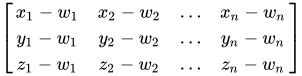
is of rank 2 or less, the 4 points are coplanar.
In the special case of a plane that contains the origin, the property can be simplified in the following way: A set of k points and the origin are coplanar if and merely if the matrix of the coordinates of the k points is of rank two or less.
Geometric shapes [edit]
A skew polygon is a polygon whose vertices are not coplanar. Such a polygon must accept at least four vertices; there are no skew triangles.
A polyhedron that has positive volume has vertices that are not all coplanar.
See also [edit]
- Collinearity
- Airplane of incidence
References [edit]
- ^ Swokowski, Earl W. (1983), Calculus with Analytic Geometry (Alternate ed.), Prindle, Weber & Schmidt, p. 647, ISBN0-87150-341-7
External links [edit]
- Weisstein, Eric Westward. "Coplanar". MathWorld.

Are Four Points Always Coplanar,
Source: https://en.wikipedia.org/wiki/Coplanarity
Posted by: fortierstroned.blogspot.com
0 Response to "Are Four Points Always Coplanar"
Post a Comment